A Jordanian looking for an accountant might type محاسب قانوني عمان, or مكتب محاسبة بالأردن, or simply accountant amman. These are the same person with the same need. Most keyword plans we inherit account for one of them.
This is the single most expensive mistake in Arabic SEO, and it is not a translation problem. It is a research problem. Arabic keyword research has to account for all three at once. Below is the method we use before writing a single page.
Three registers, one intent
Search behaviour in Jordan splits across three overlapping registers, and which one a person reaches for depends less on education than on subject matter.
Modern Standard Arabic
Formal Arabic dominates anything official, medical, legal or financial. Someone researching a tax obligation writes ضريبة الدخل في الأردن, not a colloquial equivalent. If your sector touches government, banking, healthcare or law, formal Arabic is your primary register and it is usually the highest-volume one.
Jordanian dialect
Dialect appears in consumer and service queries, especially anything spoken aloud before it is typed. Voice search has pushed this further: people dictate the way they speak. Queries like أحسن مطعم بعمان use أحسن where formal Arabic would use أفضل, and both need to exist somewhere in your content.
English and transliteration
Technical and professional queries frequently arrive in English even from fluent Arabic speakers, because the vocabulary was learned in English. A developer searches hosting Jordan, not استضافة مواقع في الأردن. Meanwhile a third pattern — Arabic words typed in Latin letters, sometimes with numerals standing in for letters — still shows up in older audiences and in messaging-driven traffic.
Why the tools underreport
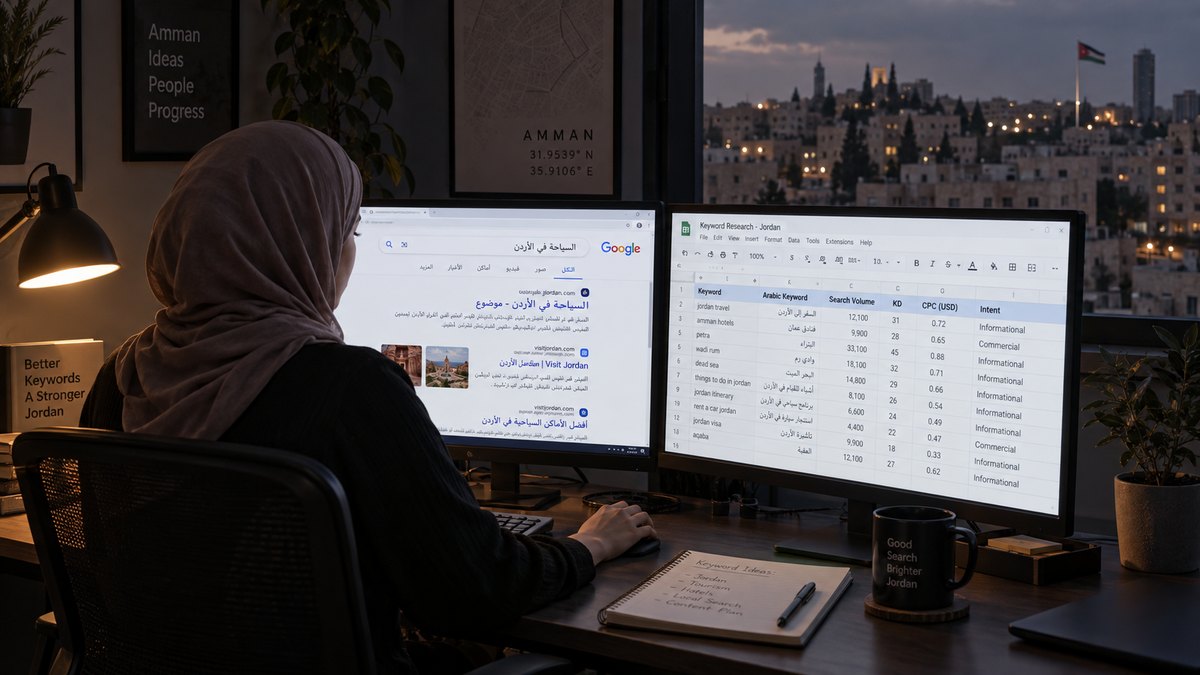
Google Keyword Planner will happily tell you an Arabic term has "10–100" searches a month while the English equivalent shows 1,000. Take that comparison at face value and you will conclude the Arabic market does not exist. Three things distort it.
- Volume buckets are wide. The free tier reports ranges, not numbers, and a term at the top of a bucket looks identical to one at the bottom.
- Arabic fragments across spellings. The same query written with and without hamza, with ة or ه, or with different diacritic choices, splits into several rows that each look small. Added together they often beat the English term.
- Planner data follows advertisers. Terms nobody bids on report thin data regardless of how many people search them.
The practical correction is to stop comparing single terms and start comparing clusters. Group every spelling variant of one intent, sum the ranges, and compare that total against the English figure.
A method for Arabic keyword research
1. Start from the language your customers use with you
Before touching a tool, read your own inbox. Contact form submissions, WhatsApp messages and sales call notes contain the exact phrasing your market uses. We have found more usable keywords in a year of enquiry emails than in an afternoon of tool exports.
2. Expand each seed across the three registers
For every service, write the formal Arabic term, the dialect term and the English term. Then check the autocomplete for each. Google's suggestions for a partial Arabic query are drawn from real searches in the country and are far more honest than volume estimates.
3. Check what already ranks
Search your terms from a Jordanian IP with the language set to Arabic. If page one is entirely Egyptian or Gulf sites, you have found an opening — a local page with genuinely Jordanian detail can outrank a bigger regional site that never mentions Amman, the dinar or local regulation.
4. Map spelling variants deliberately
Pick one canonical spelling for your content and note the variants. You do not need a page per variant; Google handles most Arabic morphological matching well. What you need is to know which variant to use in the title, because that is where exact matching still carries weight.
What this changes in practice
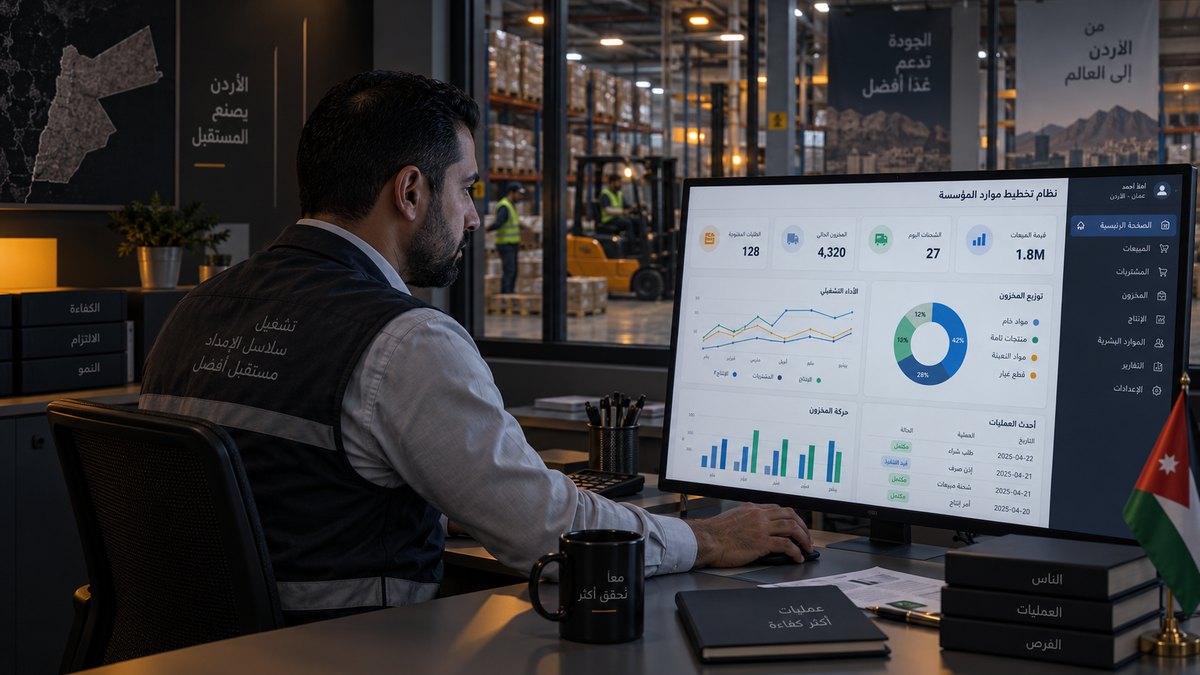
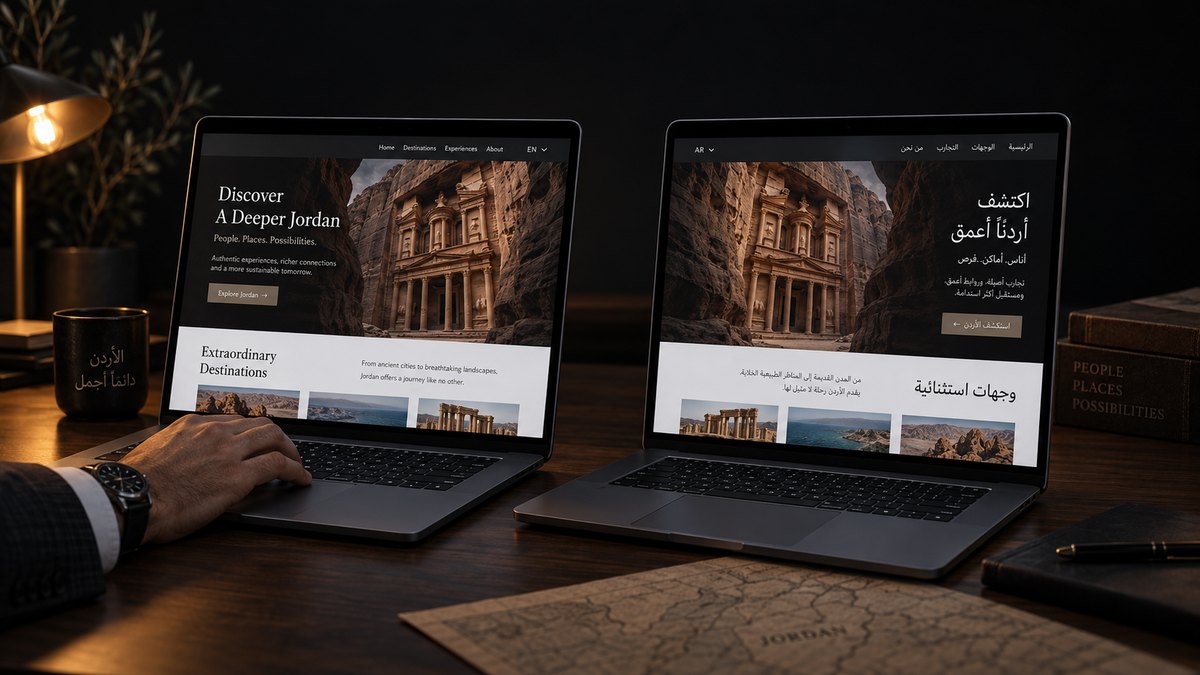
A client of ours sells industrial equipment. Their original keyword plan was thirty English terms. After running this process we found that their highest-intent traffic searched in formal Arabic for the equipment category and in English for specific model numbers. Their new structure gave each product an Arabic category page and an English specification page, cross-linked.
Organic enquiries roughly doubled inside two quarters. Nothing about the products changed. What changed was that both halves of their audience could find them in the language they were already using.
Where to start tomorrow
Arabic keyword research does not need a licence to begin. Take your five most valuable services. For each, write the three register variants and search all three from a Jordanian connection. Note who ranks. That single exercise, done honestly, will tell you more about your market position than any tool export.