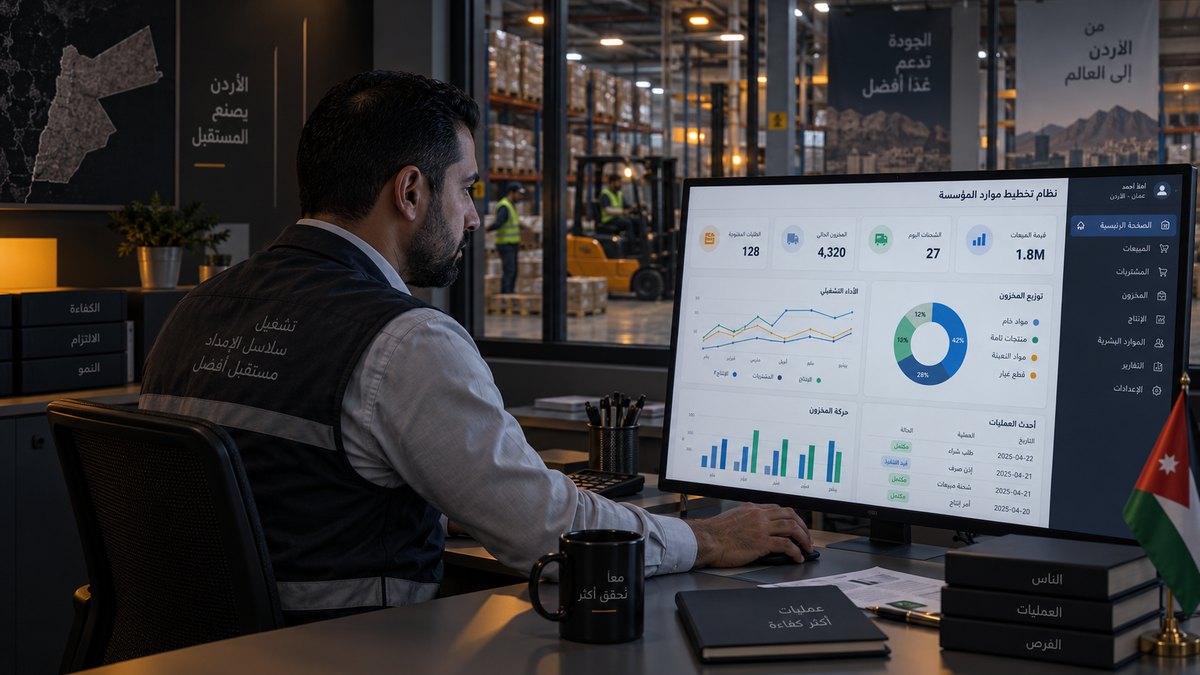
We have reviewed or rebuilt more than twenty ERP systems in Jordan over the last four years. The pattern is consistent: the software is rarely the reason a project fails. The reason is that nobody agreed on the process before the licence was signed.
This guide is what we tell clients in the first meeting — before anyone opens a vendor brochure. It covers what ERP systems in Jordan actually cost, the local compliance requirements that narrow the shortlist, and the five mistakes we see most often.
What an ERP actually replaces
An ERP is not "accounting software with extras". It is a single database that every department writes to, so that a sale, a stock movement, an invoice and a journal entry are all the same event viewed from different angles.
If your company currently runs on a mix of an accounting package, a warehouse spreadsheet, a WhatsApp group for approvals and a separate payroll system, an ERP collapses those into one record. That consolidation is the value. Everything else is features.
The signals you are ready
- Your month-end close takes more than five working days.
- Two departments quote different numbers for the same question.
- Someone re-keys data from one system into another every week.
- You cannot answer "what did we actually make on that order?" without a spreadsheet exercise.
If none of those are true, you may need better reporting rather than an ERP.
Local requirements that change the shortlist
ERP systems in Jordan carry specific obligations that generic international comparisons ignore. These three alone eliminate a large share of otherwise capable products.
JoFotara e-invoicing
The national e-invoicing system is now a practical requirement for a growing set of businesses. Any ERP you shortlist must either integrate with it natively or expose an API clean enough for a straightforward connector. Ask vendors for a working demonstration against the live system, not a roadmap promise.
Sales tax and income tax reporting
General sales tax at the standard rate, with reduced and zero-rated categories, has to be handled per line item, not per invoice. Confirm the system supports mixed-rate invoices before you commit.
Arabic and bilingual operation
Bilingual is not a translation layer. Your invoices, purchase orders and delivery notes may need to print in Arabic with correct right-to-left layout while your finance team works in English. Test printing an Arabic invoice during evaluation — this is where a surprising number of systems fall down.
Payroll and social security
Social Security Corporation contributions, end-of-service calculations and the standard leave entitlements are country-specific. Either the ERP handles them or you keep payroll separate and integrate.
What it really costs
Published licence prices are the smallest part. Budget in four buckets:
- Licences or subscription — typically 15 to 25 per cent of first-year cost.
- Implementation — configuration, data migration, integrations. Usually the largest line, often 1.5 to 3 times the first-year licence.
- Change management — training, documentation, the productivity dip while people learn. Routinely underestimated.
- Year-two support — assume 18 to 22 per cent of licence value annually.
For ERP systems in Jordan at a mid-sized company of 40 to 120 staff, a realistic first-year total lands between 25,000 and 90,000 JOD depending on module count and how much of the process is bespoke. Anyone quoting materially below that is either scoping something smaller than an ERP or has not read your requirements.
Cloud or on-premise
The honest answer for most Jordanian businesses in 2026 is cloud, with two exceptions: if you have a regulatory data-residency obligation, or if your connectivity genuinely cannot support it. Both are rarer than they were.
Cloud removes the server refresh cycle, the backup discipline problem, and the "our IT person left" risk. On-premise gives you control and a fixed capital cost. Decide on the basis of your actual constraints, not a preference for one word over another.
The five mistakes we see most
1. Buying before mapping
Document your current process — genuinely, including the informal steps — before evaluating anything. If you automate a broken process you get a faster broken process.
2. Customising too early
Every customisation is a permanent tax on future upgrades. Run the standard configuration for one full cycle before deciding what genuinely needs changing. Most of the initial customisation list evaporates.
3. Migrating everything
You do not need eleven years of history in the new system. Bring open balances, active master data and one or two years of transactions. Archive the rest somewhere queryable.
4. Treating go-live as the finish
Go-live is when the real work starts. Budget for eight to twelve weeks of intensive support afterwards, and assume adoption improves gradually rather than instantly.
5. No internal owner
An ERP project without a senior internal owner who can make process decisions will stall. The implementation partner cannot decide how your business should operate.
The best predictor of ERP success we have seen is not budget or vendor. It is whether one person inside the company has both the authority and the time to own the outcome.
A realistic timeline
- Weeks 1–3: process mapping and requirements.
- Weeks 4–6: vendor evaluation with scripted demonstrations using your own data.
- Weeks 7–16: configuration, integration and migration.
- Weeks 17–20: parallel running and user training.
- Week 21: go-live, followed by intensive support.
Compressing this is possible but expensive. Under about fourteen weeks, something is being skipped — usually training or testing, and you pay for it later.
Where to start
Write down the three questions your business cannot currently answer quickly. If an ERP would answer all three, you have a business case for one of the ERP systems in Jordan we have discussed. If it would answer none, you have a reporting problem instead, and that is a much cheaper thing to fix.